|
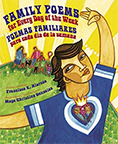 Family Poems for Every Day of the Week: Poemas Familiares Para Cada Dia de la Semana Family Poems for Every Day of the Week: Poemas Familiares Para Cada Dia de la Semana
by Francisco X. Alarcón, Maya Christina Gonzalez
Ages 7–12
This bilingual collection includes several poems for each day of the week, narrated by a boy who reflects on traditions, special occasions, and the importance of spending time with family. The colorful illustrations are inspired by Mexican indigenous crafts. |
|
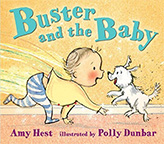 Buster and the Baby Buster and the Baby
by Amy Hest, Polly Dunbar
Ages 2–5
A small dog named Buster hides under the table and the baby darts out from the shadows. Buster dashes to hide behind the blue chair, his heard going thump, thump, thump until the toddler tracks him down again. The pair continue through the house, Buster hiding behind large objects and pursued by the clever baby, both thoroughly enjoying their game of hide and seek. |
|
 Meet Cindy Sherman: Artist, Photographer, Chameleon Meet Cindy Sherman: Artist, Photographer, Chameleon
by Sandra Jordan, Jan Greenberg
Ages 7–12
As a child Cindy Sherman loved dressing up and pretending to be someone else. When she was 10, she began taking pictures with a Kodak Brownie camera. She served as her own model in her college photography classes. A grant from the National Endowment for the Arts enabled her to move to New York City and use her camera to explore her experiences as a woman. |
|
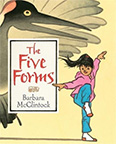 The Five Forms The Five Forms
by Barbara McClintock
Ages 4–7
A young girl finds a discarded book of martial art poses, and ignores the warning about the danger of trying the poses without the help of an experienced teacher. As she forms each pose, a real animal appears in her home. Beginning with a crane, each creature is more dangerous than the last — leopard, snake, dragon — until the fifth form returns everything to normal except the mess she has to clean up before her mother returns home. |
|
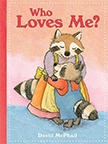 Who Loves Me? Who Loves Me?
by David McPhail
Ages Birth–3
As young raccoon Walter helps his mother make a blueberry pie, he asks again and again “Who loves me?” His mother mentions his father, his grandparents, his pets, and his friends, but Walter isn’t satisfied until she mentions the one person he is waiting for. |
|
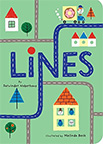 Lines Lines
by Sarvinder Naberhaus, Melinda Beck
Ages 2–4
This clever board book begins with a single line and expands to include the entire solar system, illustrating the way that simple individual pieces can make up a complex whole. |
|
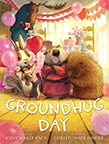 Groundhug Day Groundhug Day
by Anne Marie Pace, Christopher Denise
Ages 4–8
Moose is having a Valentine’s Day party and all his friends are invited. Groundhog wants to come but is worried that if he sees his shadow he will have to hide in his hole for six weeks and miss the party. Moose, Squirrel, Bunny, and Porcupine work together to coax Groundhog outside to play while avoiding his shadow. |
|
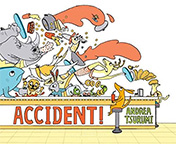 Accident! Accident!
by Andrea Tsurumi
Ages 4–7
A clumsy little armadillo named Lola spills a jug of red juice all over her family’s white sofa. Lola flees to hide in the library, but during her journey she discovers that she is not the only one who caused an accident. The city is full of others who are avoiding owning up to the disasters they are responsible for. Finally a bird helps Lola realize that it’s OK to call a mistake an accident as long as you do your best to fix the damage. |
|
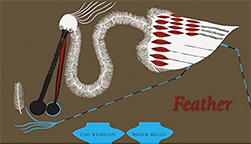 Feather Feather
by Cao Wenxuan, Roger Mello
Ages 3–7
A loose feather asks each bird she meets, “Am I yours?” hoping to be able to fly into the sky. Feather is dismissed or ignored until finally a skylark carries her into the sky, only to meet the talons of a hawk. Feather accepts that there is beauty in being close to the earth and finally finds where she belongs. |
|
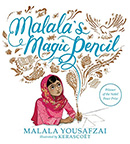 Malala’s Magic Pencil Malala’s Magic Pencil
by Malala Yousafzai, Kerascoët Kerascoët
Ages 4–8
Malala Yousafzai was born in 1997 in the Swat Valley of Pakistan. As a child she wished for a magic pencil she could use to erase the smell of garbage from her city, create an extra hour of sleep in the morning, and make everyone happy. As she grew older Malala realized there were more important things to wish for if she really wanted to make the world a better place. This picture book is based on the Nobel Peace Prize winner’s own childhood. |
|
|
|
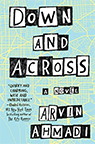 Down and Across Down and Across
by Arvin Ahmadi
Ages 12–up
Scott Ferdowsi (16) is left at home in Philadelphia while his parents visit their homeland of Iran. Scott is supposed to be doing a serious internship designed to help his college applications, but he can’t stop thinking about a study his father mentioned. Georgetown University professor Cecily Mallard stated that the chief predictor of success isn’t grades, but grit — a person’s ability to stick with something. Scott sneaks off to Washington DC to meet Professor Mallard, meeting college student Flora Buchanan whose ambition is to become a writer of crossword puzzles. Scott begins to wonder what his life’s ambition should be as he tries many new things. |
|
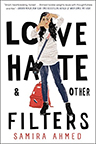 Love, Hate & Other Filters Love, Hate & Other Filters
by Samira Ahmed
Ages 14–up
American-born Maya Aziz (17) is torn between being the beloved and protected daughter of Muslim immigrants from India and the “normal” American teen-aged life of her friends. Her parents want her to attend college close to their Chicago home and date a suitable Muslim boy, but Maya dreams of going to film school in New York City and maybe even having a relationship with a boy she has liked since grade school. Maya secretly applies to New York University, but hides her dreams from her parents until the actions of a terrorist hundreds of miles away cause her neighbors and classmates to treat her and her family with prejudice, fear, and hatred. |
|
Family Poems for Every Day of the Week: Poemas Familiares Para Cada Dia de la Semana
by Francisco X. Alarcón, Maya Christina Gonzalez
Ages 7–12
This bilingual collection includes several poems for each day of the week, narrated by a boy who reflects on traditions, special occasions, and the importance of spending time with family. The colorful illustrations are inspired by Mexican indigenous crafts. |
|
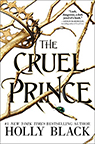 The Cruel Prince The Cruel Prince
by Holly Black
Ages 15–up
At the age of seven, Jude Duarte witnessed the murder of her parents by the High King of Elfhame’s general. Jude and her two sisters were taken to Fairyland, where the High King raised them as his own daughters. Now 17, Jude is still bullied by Prince Cardan, the king’s youngest son, and his friends. Jude dreams of becoming a member of he High Court, hoping to use that power to bring justice, and jumps at the chance to serve one of Cardan’s brothers. That places her in the midst of a violent coup, endangering everyone she loves. (first in a planned trilogy) |
|
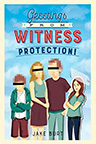 Greetings from Witness Protection! Greetings from Witness Protection!
by Jake Burt
Ages 10–14
Nicki Demere, a 14-year-old orphan and pickpocket, is plucked from the foster care system by the U.S. Marshals to pose as the daughter of a family hiding from a deadly crime organization. The Marshals figure that the mobsters are looking for a family with only one son, and adding Nicki to the mix may be the family’s only chance of surviving in the Witness Protection Program. |
|
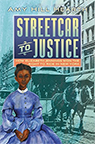 Streetcar to Justice: How Elizabeth Jennings Won the Right to Ride in New York Streetcar to Justice: How Elizabeth Jennings Won the Right to Ride in New York
by Amy Hill Hearth
Ages 8–12
Elizabeth Jennings, a young African-American schoolteacher on her way to church in July 1854 took a seat on a New York streetcar. She was physically removed from the streetcar by the conductor and a police officer and arrived home bruised and injured. With the support of her family, the African American abolitionist community of New York, and Frederick Douglas, Elizabeth took her case to court. Her lawyer was future president Chester A. Arthur. Her victory played a major role in desegregating public transportation in New York City. |
|
Meet Cindy Sherman: Artist, Photographer, Chameleon
by Sandra Jordan, Jan Greenberg
Ages 7–12
As a child Cindy Sherman loved dressing up and pretending to be someone else. When she was 10, she began taking pictures with a Kodak Brownie camera. She served as her own model in her college photography classes. A grant from the National Endowment for the Arts enabled her to move to New York City and use her camera to explore her experiences as a woman. |
|
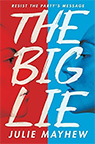 The Big Lie The Big Lie
by Julie Mayhew
Ages 14–up
Jessika Keller (17) lives in 2014 alternative England under a Nazi regime. The dutiful daughter of a Reich minister, Jesskia is model student and a champion ice skater. Her best friend Clementine is the complete opposite: outspoken, radical, and dangerous. The two have been best friends since they were seven, and Jessika has recently discovered that she loves Clem as more than a friend. Homosexuality is illegal in Nazi England, and Jessika knows she must choose between her perfect life and the girl she loves. |
|
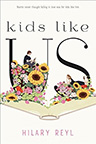 Kids Like Us Kids Like Us
by Hilary Reyl
Ages 12–up
Martin (16) is an American living in France for the summer with his mother and sister. Martin, who is on the autism spectrum, falls in love with a French girl who he thinks is a real-life version of a character in his favorite book: Proust’s In Search of Lost Time. Martin eventually comes to realize that the girl is a real person equally as interesting as a character in a book, and that love is possible even for American teens on the autism spectrum. |
|
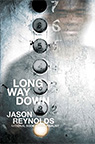 Long Way Down Long Way Down
by Jason Reynolds
Ages 12–up
Will (15) is intent on killing whoever killed his older brother Shawn. Carrying Shawn’s gun, Will gets on the elevator and heads down, sure he knows his target. As the elevator stops at each floor, Will learns something new about Shawn from the ghosts of people killed by guns, both intentional and unintentional victims. The entire novel, narrated in narrative verse, takes place during that 60 second elevator ride down. |
|
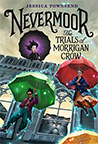 Nevermoor: The Trials of Morrigan Crow Nevermoor: The Trials of Morrigan Crow
by Jessica Townsend
Ages 8–12
Morrigan Crow (nearly 11) was born on Eventide, the unluckiest day of the year. For her entire life Morrigan has been blamed for every misfortune in the Wintersea Republic, from burnt bread to heart attacks. Worst of all, Morrigan is doomed to die at midnight on her eleventh birthday. That night a terrifying pack of shadow wolves try to hunt her down, but luckily Jupiter North of the Wonderous Society smuggles her into Nevermoor as his apprentice. To stay in Nevermoor, Morrigan must pass four entrance trials, competing against 500 incredibly talented children for only nine spots. Morrigan can’t figure out what her talent is, but for the first time in her life she has friends and she is determined to escape her fate. (first in a planned series) |
|
|